

Summary: This article traces rainwater harvesting from Roman aqueducts and medieval cisterns through industrial-era gutter systems to today’s smart filtration technology. The practical takeaway is that modern gutters and storage tanks let homeowners conserve water and protect their property, continuing a practice thousands of years old.
At Rockstar Rain Gutters, we help homeowners and businesses make the most of every drop of water, and it all starts with smart systems and smarter planning. One question we hear often is: How did rainwater harvesting begin, and how did it become what it is today?
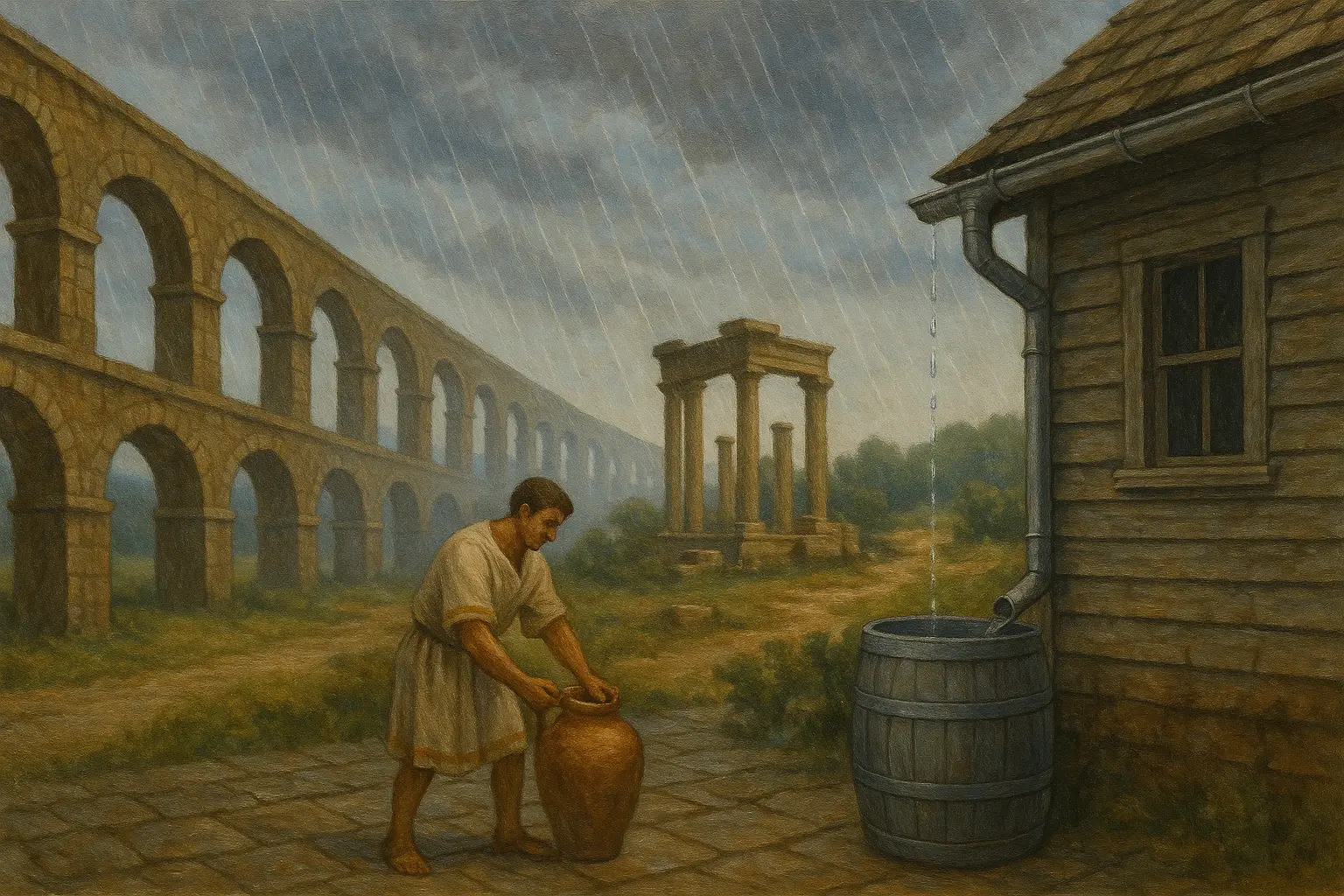
Long before modern plumbing, ancient civilizations were already engineering ways to collect and store rain. The Romans built sophisticated aqueducts, while early Indian and Chinese societies dug underground cisterns. These early rainwater harvesting systems weren’t just clever. They were crucial to survival.
Over time, these ideas evolved into the rainwater management solutions we rely on today. With increasing pressure on municipal water supplies, modern homes now use gutters, downspouts, and storage tanks not just for convenience, but as a way to conserve resources and protect their property from water damage.
What is Rainwater Harvesting?
Rainwater harvesting is the practice of collecting and storing rainwater for future use. This technique can be traced back to ancient civilizations, where water was collected to be used for drinking, irrigation, and various daily needs. Over time, rainwater harvesting systems have evolved from simple containers to complex systems involving gutters, downspouts, and filtration methods. Today, rainwater harvesting is widely used in both rural and urban settings to supplement water supplies, especially in areas where freshwater resources are limited or unreliable.
| Era | Time Period | Key Development |
|---|---|---|
| Roman Empire | 500 BCE to 500 AD | Aqueducts and underground cisterns |
| Middle Ages | 500 to 1500 AD | Castle and monastery water storage |
| Industrial Revolution | 1700s to 1800s | Advanced water infrastructure built |
| Urbanization | 1800s | Gutter systems introduced for homes |
| Modern Era | 1900s to present | Filtration, pumps, and smart systems |
The Early Beginnings of Rainwater Harvesting
Rainwater harvesting is one of the oldest water management systems in human history. Ancient civilizations understood the value of collecting rainwater for its practical uses. The systems they developed laid the groundwork for modern practices.
- The Roman Aqueducts and Cisterns (Around 500 BCE to 500 AD)
The ancient Romans were pioneers in water management. Between 500 BCE and 500 AD, they developed an extensive system of aqueducts and cisterns to supply cities with water. The Romans built aqueducts to transport water from distant sources to urban areas, supplying water for drinking, public baths, and fountains. While aqueducts primarily served to bring fresh water into cities, they also played a significant role in rainwater collection and management.
Roman cities had large underground cisterns where rainwater was stored. These cisterns were often built under homes, public buildings, and temples to catch and store rainwater from rooftops. The water was stored in large tanks and could be used when fresh water was scarce. The use of these cisterns became widespread across the Roman Empire, especially in regions with limited access to natural freshwater sources. The famous city of Rome itself had several large cisterns, and it’s believed that some of them were capable of holding millions of gallons of water.
- Early Use of Rainwater Cisterns in Other Civilizations
In addition to the Romans, several other ancient civilizations also developed cisterns for rainwater harvesting. In ancient Egypt, for instance, people collected rainwater to supplement the water available from the Nile River. Similarly, ancient Greek cities used cisterns to store rainwater, particularly in areas where fresh water was scarce.
These early water systems were vital for survival, especially in areas where reliable access to freshwater was not always available. The use of cisterns continued in many regions throughout history and was a key practice in societies dependent on water conservation for agriculture, domestic use, and survival.
Rainwater Harvesting in the Middle Ages (500 AD: 1500 AD)
During the Middle Ages, rainwater harvesting continued to be a crucial practice, particularly in castles, monasteries, and rural areas. As populations grew, so did the demand for water. In Europe, many castles were designed with rainwater collection systems, where water was stored in large cisterns or wells. These systems ensured a steady supply of water, even in times of drought.
In medieval England, for instance, rainwater was collected from rooftops and stored in barrels or large stone cisterns. These systems were often connected to elaborate drainage systems that helped direct rainwater away from buildings and into storage tanks.
The Industrial Revolution and the Rise of Modern Water Systems (1700s-1800s)
With the advent of the Industrial Revolution in the 18th and 19th centuries, urbanization and population growth brought new challenges to water management. As cities expanded, so did the need for reliable water systems. The Industrial Revolution led to the creation of more advanced water infrastructure, including large-scale rainwater collection and distribution systems.
Gutter Systems and Urbanization
In the 19th century, the growing urban population meant that rainwater harvesting systems had to evolve to meet the demands of urban environments. One of the most important innovations during this period was the creation of gutter systems. Gutters were designed to collect rainwater from the roofs of homes and direct it into downspouts, where it could be directed to storage tanks or drainage systems.
Gutters became a staple of home construction in cities around the world, and their role in rainwater management expanded. In addition to collecting rainwater for irrigation and other non-potable uses, gutters helped prevent water damage to homes by directing rainwater away from the building’s foundation.
The Rise of Water Treatment and Filtration Systems
By the late 19th and early 20th centuries, water treatment and filtration systems had begun to develop. Cities around the world started implementing municipal water systems that treated and distributed water to residents. However, in rural and remote areas, rainwater harvesting systems remained vital, as they provided an alternative water source when municipal systems were not available.
In the early 1900s, many homes began to install rainwater storage tanks with filtration systems to ensure the collected water was safe for use. These systems continued to evolve, with more advanced filtration methods and pumps being added to improve water quality and delivery.
Modern Rainwater Harvesting Systems (1900s: Present)
Today, rainwater harvesting systems have become more efficient and accessible than ever before. Technological advancements have led to the development of sophisticated systems that allow people to collect, store, and use rainwater for a variety of purposes. These systems can be found in homes, businesses, and even large-scale public buildings.
- The Rise of Eco-Friendly Practices
In recent decades, there has been a renewed interest in rainwater harvesting as a sustainable and eco-friendly practice. As concerns about climate change and water scarcity have increased, more people are turning to rainwater harvesting to supplement their water supply. In some regions, rainwater harvesting is now seen as a key part of water conservation efforts.
As gutter systems grew more common, homeowners began weighing their options for materials, since the choice between metals like copper and aluminum affects both long-term durability and cost. If you’re curious how those trade-offs break down today, Copper Rain Gutters vs Aluminum Rain Gutters: Are Copper Gutters Worth the Investment? walks you through exactly what you need to know before making a decision.
Rainwater harvesting systems today can include advanced filtration units, rainwater barrels, automated pumps, and even smart technology that monitors water levels and usage. Many modern systems are integrated with home irrigation systems, providing water for landscaping and gardens. Rainwater collected from roofs is used for everything from flushing toilets to cleaning, and in some cases, it’s even used as drinking water after proper treatment.